

On Learning to Write A Bike
and on doing so in the middle of a highway

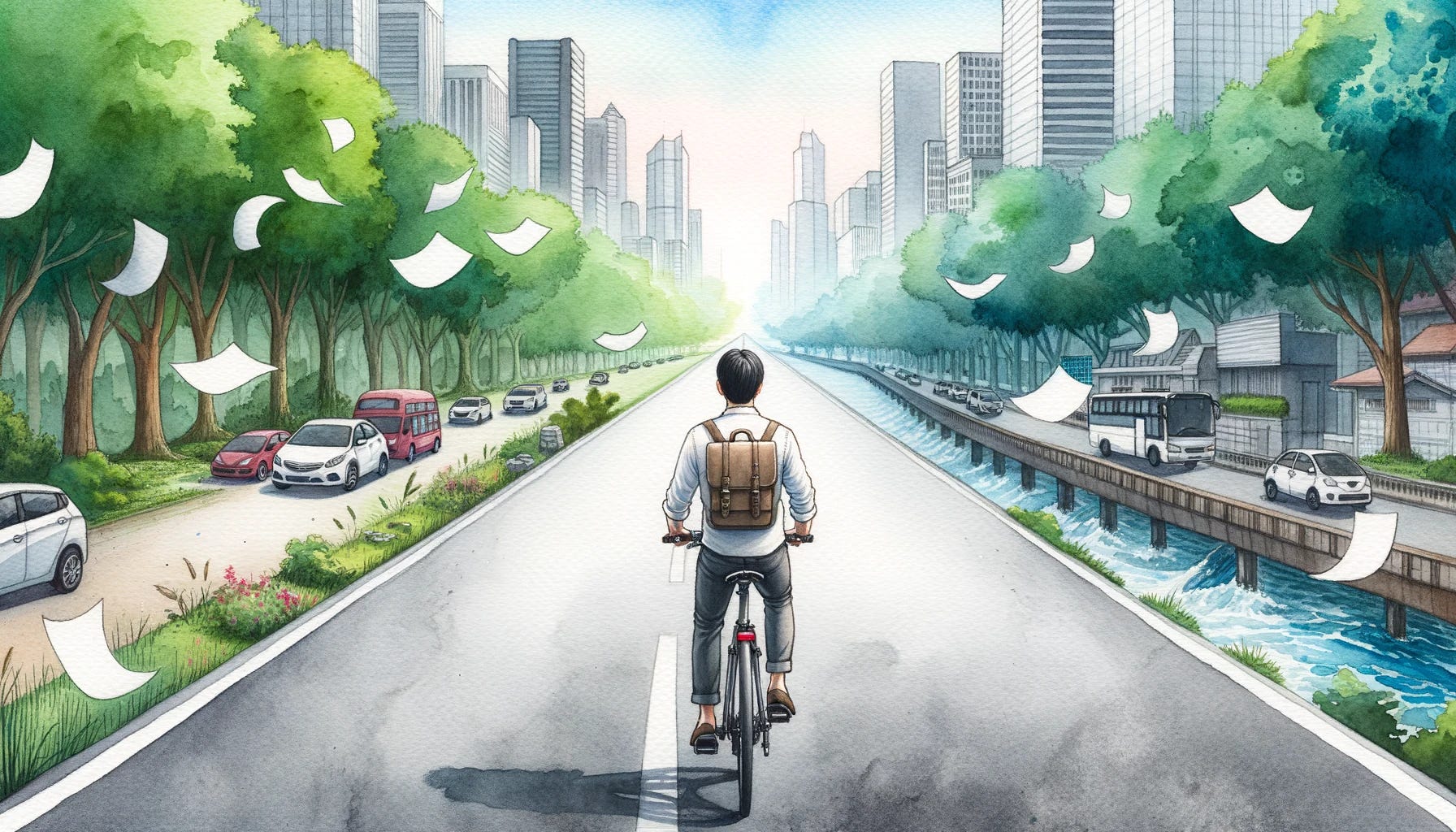
Learning new skills is hard, and it's a challenge that only grows with age. As a child, I was utterly perplexed by the art of whistling, yet I never fell short of enthusiastic instructors. Time and again, adults would eagerly jump in with a plethora of advice, demonstrating how to expertly pucker my lips and meticulously contort my tongue. After countless attempts and myriad well-meaning instructions, I finally transitioned from producing nothing more than a faint whisper of air to unleashing sounds reminiscent of a malfunctioning kettle. But that was good enough for me; I learned how to whistle.
It's different as an adult. A lack of knowledge, once an opportunity for growth, becomes a source of shame. Imagine, if you will, reaching the ripe old age of 30 without ever mastering the art of shoelace tying. You’ve navigated the complexities of adult life, perhaps you've earned a degree or landed a decent job, but confronted with a pair of untied sneakers, you’re as helpless as a kitten on its back. In the face of potential ridicule, the sanctuary of flip-flops and slip-ons becomes one's residence for life, providing a protective barrier from the critical eyes of our social circles.
The internet can teach you some skills outside of the public eye; there’s no shortage of how-to guides online that impart the age-old wisdom of shoelace tying, though these tutorials tend to lack the whimsical charm (think: bunny ears and looping adventures) of the instructions bestowed upon children. On the other hand, acquiring skills such as swimming or bike riding entails navigating a much steeper learning curve. They call for an unspoken understanding, a kind of tacit knowledge that can’t be neatly packaged in an online tutorial, as well as a boldness to confront the very real risks of injury or even drowning. In these cases, the presence of a guide, a mentor, or even just a friend to catch you and cheer you on, becomes indispensable.
The art of writing, which I am currently striving to master, presents its own unique set of perils. The threats here are not of a physical nature but are instead rooted in the mental and social spheres. It's akin to learning to ride a bike, but with the added scrutiny of curious neighbors peering over their lawns. In writing, the pressure is perhaps even higher; you don't just happen upon an audience—you must actively seek one out, inviting them into your process.
Virtual audiences are renowned for their vocal stances on the 'correct' way to ride a bike, leading even the most well-meaning learners into the crosshairs of online rage. Those positioned on the left might misconstrue your right-hand turn signal for a Sieg Hiel salute, while the right-leaning observers could take issue with your handlebar grip, deeming it a departure from traditional bicycling values.
Given these potential pitfalls, it seems wise to choose a side of the road and steadfastly adhere to it. In doing so, you ensure that when the inevitable backlash comes, you have allies on ‘your side’ ready to come to your defense. Unfortunately, I am habitually drawn to the center of the road, attracted to the profound thinkers and transformative ideas that span the ideological spectrum, uninterested in blind allegiance to a single group.
Engaging with contentious topics is part and parcel of writing from the middle of the road, and while I don’t seek to stir up controversy, I also refuse to shy away from it. 'Cancellation' might not be an imminent threat, but I’m not prepared to self-censor or risk my job security. This has led me to the decision to write pseudonymously, embracing the irony that anonymity can sometimes be a prerequisite for authenticity. Just as one would wisely wear a helmet while navigating the center of the street on a bike, I am taking necessary precautions in my writing journey.
I’ve stood in the middle of the road several times before, hesitating at the brink of a creative undertaking. I might have pedaled a bit, but I always stopped while my feet could still find the safety of the ground. Yet, the secret to not losing your balance on a bike, and in writing, is to keep pedaling. In learning to bike, you have someone cheering you on, telling you to pedal harder; in writing, I’m hoping that someone can be you. Subscribing, commenting, or simply sending a note of encouragement could make all the difference, propelling me forward. If you ever feel like discussing my work, future articles, or anything else, please reach out for a conversation. Writing is often a solitary endeavor, and your companionship would be immensely valued.
My aim is to publish an article weekly for the upcoming two months. But what exactly will I be writing about? That’s a great question, and truthfully, I’m not entirely sure myself. Drawing a parallel from learning to ride a bike, where it’s often recommended not to fixate on the steering, I plan to embrace a similar approach in my writing, letting my thoughts flow freely and seeing where they take me. I’m excited to see where I end up.
Whether you find yourself nodding along to my words or simply waiting to see if I can maintain my balance, I’m glad you’re here. Because, let’s face it, there’s something undeniably amusing about watching someone learn to ride a bike, even if—or perhaps especially if—it involves a few spectacular crashes. Armed with a keyboard and a plethora of ideas, I’m setting out to navigate the middle of the road, embracing the vulnerability that comes with learning in public. I can’t promise a flawless ride, but I can promise authenticity, passion, and a commitment to finding balance, one word at a time.
I can’t wait for next week’s post! Bike writing seems to come natural to you. Thank you for the well ridden entry and Keep on Writing! (From a fellow middle of the roader)
I love this! And I’m confident there is a growing community of fellow middle of the roaders that are ready to take this ride with you - myself included! Thanks for [w/r]i[d/t]ing.